Why "Fast" Drivers Aren't What You Think
You have read it a thousand times in forums and reviews: "the cone needs to be light, otherwise the driver can't be fast." It sounds logical. A heavy thing is hard to move quickly, right?
It is also one of the most stubborn myths in loudspeaker design. Not because audiophiles are wrong about everything they hear — but because the word "fast" is doing a lot of work, and almost none of it has to do with mass.
"Speed" in a driver is bandwidth, not low mass.
A heavy cone with a strong motor and low voice-coil inductance can out-transient a light cone with a weak motor every time.
If you only look at Mms on the datasheet, you are looking at the wrong number.
What the Myth Gets Right
Let us be fair before we tear it apart. Low moving mass does matter — just not for the reason most people think. For a given motor strength Bl and voice-coil resistance Re, the reference efficiency of a driver scales roughly as:
So a lighter cone gives you more SPL per watt. That is real, that is useful, and it is why pro drivers and high-sensitivity hi-fi designs go to lengths to keep Mms down. But efficiency is not the same as transient response. The two get conflated, and that is where the trouble starts.
So What Is Speed?
Sound pressure in the far field of a piston in a baffle is not proportional to displacement. It is not proportional to velocity either. It is proportional to acceleration:
Where U is volume velocity (cone area times cone velocity). A sharp transient — a snare hit, the leading edge of a kick drum — is a steep slope in pressure, and a steep slope in pressure means a sharp burst of acceleration at the cone.
Now apply Fourier. A perfectly steep edge in the time domain requires infinite bandwidth in the frequency domain. The faster the rise time you want, the higher the frequencies you have to faithfully reproduce. That is not philosophy, that is signal theory.
"Speed" is bandwidth. A driver is as fast as the highest frequency it can still produce cleanly.
This single shift in framing makes the rest of the article easy. Stop asking "is this driver fast?" and start asking "where does this driver run out of bandwidth, and why?"
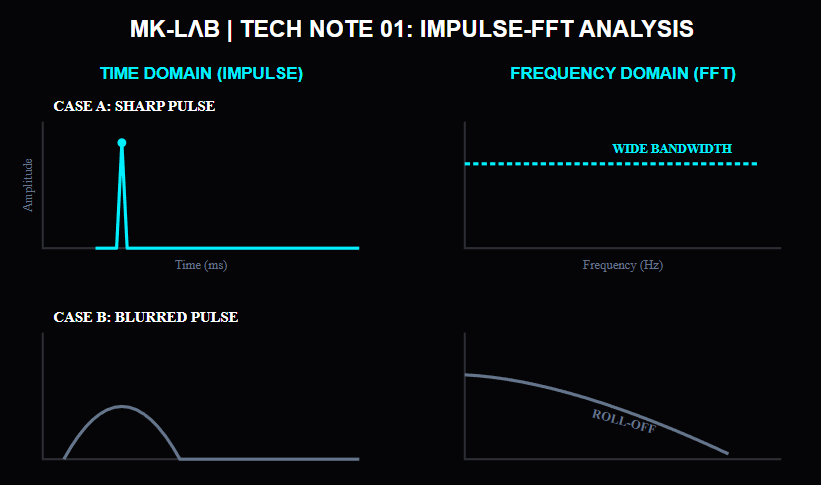
The Real Villain: Voice-Coil Inductance
If "speed = bandwidth," then anything that limits high-frequency bandwidth limits transient response. And by far the most common, most underestimated culprit is not the cone. It is the voice coil itself.
The voice coil is an inductor. Together with its DC resistance Re, it forms a first-order low-pass filter on the current — and therefore on the force the motor can produce — with a corner frequency of:
Plug in numbers. A typical 8 Ω woofer with Le = 1.5 mH already starts rolling off at around 700 Hz. By 7 kHz the motor is producing 20 dB less force than it "should" for the same input voltage. The cone has not even had a chance to be heavy or light yet — the current never made it through.
This is why drivers with shorting rings, copper caps, and short voice coils on long gaps can sound so much more impulsive than their Mms alone would suggest. They are not lighter. They are wider.
The Other Bottlenecks
Once the current is through, there are still places bandwidth can leak out:
- Cone breakup. Above some frequency the cone stops moving as a piston and starts ringing in nodal modes. Energy goes into the cone instead of the air, then comes back out at the wrong time. Material and geometry matter here, not raw mass.
- Mechanical and electrical damping. Poor damping (low Rms, low BL² / Re) means the cone keeps oscillating after the signal has stopped. The transient leading edge can look fine; the trailing edge is a mess.
- Suspension non-linearity. Spider and surround stiffen with excursion. At loud transients the restoring force changes mid-stroke, smearing the impulse asymmetrically.
None of those have Mms in them. All of them limit how cleanly a driver reproduces a transient.
How to Actually Read a Datasheet
If you want to predict transient performance from spec sheets, here is a more honest checklist than "low Mms":
- Le at 1 kHz and 10 kHz. If the second number is much smaller than the first, the driver has motor topology that fights inductance. That is good. If only one number is given, assume the worst.
- BL² / Re (motor strength factor). High values mean strong electrical damping. This controls the trailing edge of every transient.
- Cumulative spectral decay (waterfall) plots. Worth more than any T/S parameter. Long ridges = stored energy = smeared transients.
- Fs and Qts tell you about the low-frequency end, which has nothing to do with transient sharpness despite what some reviewers will swear.
The Takeaway
The audiophile instinct to want a "fast" driver is not wrong. The diagnosis — that mass is the problem — almost always is. A 40-ton truck can accelerate as hard as a sports car if its engine is big enough. A 40-gram cone can be more impulsive than a 12-gram cone if its motor has the bandwidth to drive it.
Next time you see a 6.5" woofer marketed as "lightning-fast because of its 8.2 g cone," check what its inductance does above 1 kHz. That is where the actual story lives.